Cult: The American Dream: Group Show


-
 Andrew J. Park
Sustenance, 2026 -
David Moy
Sarah/Stevie, 2025 -
Eleanor Schiltz
Another Trail Encounter, 2026 -
Daniel Wang
Diner Roleplay, 2025 -
Julie Yeo
The Big Sun, 2025 -
Julie Yeo
Are My Shoulders Too Big Now?, 2026 -
Daniel Wang
Shooter, 2025 -
Ian Davis
Water tower, 2021 -
Hunter Potter
Musical Chairs, 2026 -
Nichole Fitch
Abyssinian maids, 2026 -
Nichole Fitch
Drunk with Paradise, 2026 -
Hunter Potter
Like Clockwork, 2026 -
Hunter Potter
When Cardinals Appear, 2026 -
Marina Ross
Roses, 2026 -
Marina Ross
Mother Daughter, 2026 -
Marina Ross
Hurricanes, 2026 -
Laura Watters
Now I am too beautiful to be set free, 2026 -
Sean Walker Hutton
Temple, 2025 -
Sean Walker Hutton
Vesper, 2025 -
Sean Walker Hutton
The Stone, 2025 -
Sean Walker Hutton
Woke Up Sleeping, 2025 -
Will Maxen
Untitled (home), 2026 -
Ruoyi Shi
Cloud Catcher, 2024 -
Hunter Potter
All Roads Lead to Rome, 2022 -
Jamie John Davies
Hearken, littl’ fiend! Thou wicked scucca, thou lowly ācweorna with deofelseoc, pitiful keeper of naught. Aye, I swear by mine own blood thou hast spilt, I shall grind thy skull ‘neath mine heel and shatter thy ugly pate, that all men may lay witness to the noisome blight that doth inhabit thee!, 2025


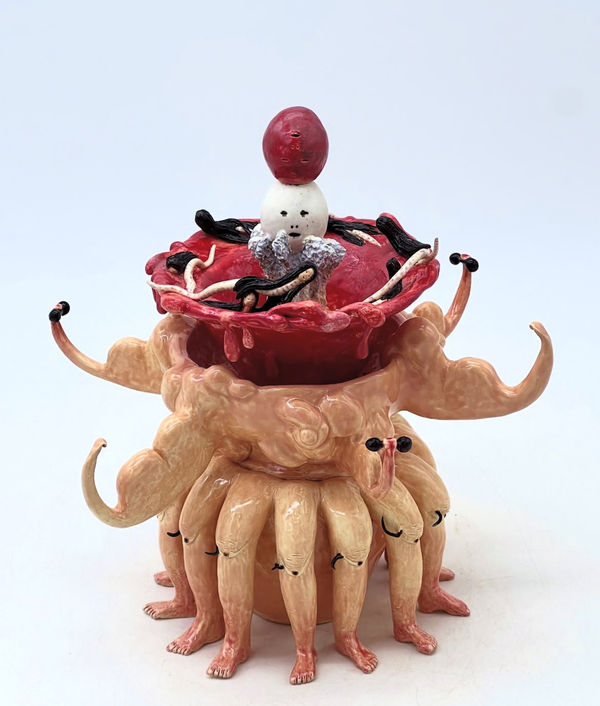


Make Room Los Angeles presents CULT: THE AMERICAN DREAM, a group exhibition curated by Zachariah Buteux that explores how the promise of the American Dream can evolve into something more insular, ritualized, and consuming.
The American Dream has often been framed as opportunity and upward mobility. But it has always functioned as a belief. The house, the porch, the flag, the open road, the small town diner. These images form a mythology that generations have inherited. Rooted in White Christian ideals and reinforced through media and politics, this Dream offers structure, stability, and moral clarity. It offers belonging.
It also requires alignment.
American culture has long produced tightly knit communities organized around shared convictions. From early Puritan settlements and westward religious migrations to utopian movements, from Jonestown to modern conspiracy networks, the United States has repeatedly produced environments where belief becomes cemented in identity. When institutions feel unstable and authority feels fractured, smaller circles of certainty grow stronger. Language shifts. Doubt becomes weakness. The individual voice slowly merges into the collective.
CULT: THE AMERICAN DREAM is structured to unfold like a play. The exhibition moves in acts, beginning with images that feel grounded in classic American identity, stable and familiar. As viewers progress through the space, the tone gradually shifts. Nostalgia becomes unease. Community becomes conformity. Belonging begins to resemble submission. By the final movement, the atmosphere is no longer aspirational but devotional.
The exhibition is accompanied by “Excerpts From a Fictional Diary, 1961-1978.” The entries follow a man who loses his family, searches for meaning, finds community in a religious movement, and slowly surrenders his autonomy. His language changes over time. “I think” becomes “we know.” Memory blurs.
Identity dissolves. The diary acts as the script beneath the visual work, guiding the descent from personal grief to collective entanglement.
The artists in the exhibition engage this progression in different ways. Some immerse fully in the aesthetics and psychology of cult behavior. Others work within the visual language of Americana while exposing its fractures. Porches, diners, water towers, deserts, and cultural icons appear at first recognizable, then charged, then constrained. What once symbolized comfort begins to suggest surveillance, repetition, ritual.
At a time marked by visible state power, intensified immigration enforcement, political polarization, rapid technological change, and the spread of conspiracy culture, this exhibition asks a direct question. When does belief become ritual, and when does ritual become surrender?
CULT: THE AMERICAN DREAM does not offer easy answers, any answers, really. Instead, it invites viewers to experience a slow shift in atmosphere, to feel how systems of faith, nationalism, and collective identity can tighten around the individual. The American Dream remains powerful. This exhibition aims to examine what happens when that power is intensified, isolated, and accepted unequivocally.